
Rapid Radios Work
A fleeting pulse of electromagnetic radiation known as a fast radio burst (FRB) baffled astronomers for years. FRBs are millisecond flashes that occur sporadically throughout the sky and have yet to be linked to any known source. This company claims their walkie-talkies won’t depend on cell phones and will work even during a disaster where cell phone carriers are bogged down. They are lying. The transmitter is a necessary component part of any electronic device that sends radio waves, including radio (audio) and television broadcasting stations, cell phones, walkie-talkies, Bluetooth devices, garage door openers, two-way radios aboard aircraft, ships, spacecraft and radar sets. It generates oscillating coupled electric and magnetic fields that are transmitted by antennas as radio waves to a remote receiver.
A rapid radios signal can travel great distances through free space without losing much power, but it may be degraded by attenuation by atmospheric loss or reflected off land or water. This is what makes it possible to communicate over long distances, although the transmission range is usually limited to line of sight. Most modern transmitters are based on spark gap technologies developed by Heinrich Hertz and Guglielmo Marconi in the late 1800s, which use high voltage spark between conductors to generate radio waves. They can transmit audio but are used for telegraphy to transmit and receive text messages in Morse code.
Using an antenna, the receiver converts some of the energy from a radio wave into a DC electric voltage that it puts out. The voltage varies with the distance from the transmitter and also the conditions on the path of the waves, such as multipath interference. The receiver separates out the desired signal by bandpass filtering. The filter allows the incoming signal to pass, and blocks all other signals at frequencies that are near it in frequency. This information (modulation) is carried in the two sidebands of the transmitter’s carrier frequency, so the filter has to have a broad bandwidth to allow the sideband frequencies through but narrow enough to reject interference.
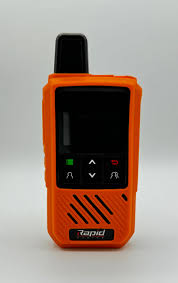
How Do Rapid Radios Work?
The recovered signal can be amplified directly by a local oscillator (synchrodyne or direct conversion receiver), or shifted down to an intermediate frequency and then amplified, filtered and demodulated (superheterodyne receiver). In either case the strength of the resulting signal varies with the amplitude of the original transmitter, so there may be a feedback control system in the receiver that adjusts the gain of amplifiers based on this variable input level.
Rapid radios provide high-speed instant group and individual voice communications at broadband quality levels not possible through traditional land mobile radio (LMR) technology. It is a fully IP communications system utilizing a combination of existing public and private cellular networks, and local network Wi-Fi or Ethernet connection to the RAPID server. Push-To-Talk (PTT) allows users to communicate instantly with a simple button press, sending audio over the radio network and enabling one-to-many communication. It also includes a variety of digital capabilities such as text, multimedia, files, status, and location.
The company claims their walkie talkies are a “nationwide LTE Push to Talk Walkie-Talkie set” and that they have NO MONTHLY FEE – but what they really mean is $50 per radio a year which will probably continue to be charged even after the EMP hits and cell towers go dark. They also don’t answer the question, “Will it work in an area without cellular coverage?”, which is a big no.
Unlike most walkie talkies that use cellular networks that depend on cell phone tower sites, rapid radios operate independently of cellular networks and have no monthly fees. This enables high-speed instant group and individual voice communications at broadband quality levels that are impossible with other devices. The software and data is securely hosted on selected AWS platforms ensuring highest security and reliability. Rapid offers unlimited RF range* and nationwide service with no monthly fees or contracts.
The software allows you to easily manage on air content, importing feeds from NPR’s MetaPub and Composer services. Editing messages, shows and music tracks are simple and easy. Rapid logs all content that is broadcast and identifies the duration of each track played, allowing you to review what was aired or streamed. The system also includes support for a variety of automation systems.

